In today's competitive food and beverage market, brands are constantly searching for ingredients that deliver both functionality and consumer appeal. freeze dried fruits have emerged as a powerful tool in the product developer's toolkit, offering a rare combination of extended shelf life, concentrated flavor, and clean-label credentials. Whether you're formulating a new snack, beverage, or functional food product, understanding how these ingredients can shape your development strategy is essential to staying ahead of market trends.
Freeze dried fruits are produced through a process called lyophilization, where fresh fruit is frozen and then subjected to a vacuum that removes moisture through sublimation. The result is a lightweight, highly stable ingredient that retains the natural color, aroma, nutritional value, and taste of the original fruit with remarkable fidelity. For product developers, this means access to a versatile raw material that opens new formulation possibilities across multiple categories, from breakfast cereals and baked goods to protein bars and premium confectionery.
One of the most compelling reasons to incorporate freeze dried fruits into your product development strategy is their extraordinary flavor concentration. Because the lyophilization process removes up to 98% of moisture while preserving the cell structure of the fruit, the resulting ingredient delivers a significantly more intense taste experience than its fresh or conventionally dried counterparts. This allows formulators to use smaller quantities to achieve a bold, authentic fruit flavor profile.
For categories like premium snack bars, trail mixes, and artisan confectionery, this concentrated sensory performance is a direct competitive advantage. Consumers increasingly expect real fruit taste in their products, and freeze dried fruits allow brands to meet that expectation without resorting to artificial flavors or synthetic enhancers. The clean, vibrant taste signals quality and naturalness, both attributes that command premium pricing in today's market.
Beyond taste, the texture of freeze dried fruits also contributes meaningfully to the sensory experience. Their characteristic crunch, which softens predictably when it absorbs moisture from surrounding ingredients, gives product developers precise control over texture dynamics. This is particularly valuable in layered or composite products where textural contrast is a key differentiator.
Modern consumers scrutinize ingredient labels more carefully than ever before, and they reward brands that can demonstrate transparency and nutritional honesty. Freeze dried fruits align perfectly with clean label product strategies because they are typically produced without added sugars, preservatives, artificial colors, or chemical treatments. The single-ingredient simplicity of freeze dried fruits is a powerful marketing asset that resonates strongly with health-conscious shoppers.
From a nutritional standpoint, the lyophilization process is notably gentle compared to heat-based drying methods. It preserves a significantly higher proportion of heat-sensitive vitamins, particularly vitamin C and certain B vitamins, as well as antioxidants and polyphenols. When you incorporate freeze dried fruits into a functional food or nutraceutical product, you are adding genuine nutritional value that supports front-of-pack health claims with credibility.
This nutritional integrity also supports regulatory compliance in markets with strict fortification or health claim standards. Product developers working in regulated categories such as sports nutrition, infant food supplements, or clinical nutrition can leverage freeze dried fruits as a natural, documentable source of specific micronutrients without complicating their compliance pathway.
The snack and cereal segments represent some of the most dynamic opportunities for incorporating freeze dried fruits into a product development strategy. In ready-to-eat cereals and granolas, freeze dried fruits provide vibrant color clusters that make the finished product visually appealing on shelf. Unlike fresh fruit, which would rapidly compromise the moisture balance of a dry cereal, freeze dried fruits remain shelf-stable and maintain their structural integrity throughout the product's intended lifespan.
In snack formats, freeze dried fruits can be used whole, as slices, or in powder form depending on the desired application. Whole or sliced freeze dried fruits work beautifully as inclusions in trail mixes, yogurt toppings, and premium nut-based snack products. Powdered freeze dried fruits, on the other hand, offer extraordinary flexibility for coating applications, flavoring bases, and compound chocolate formulations where a smooth dispersion of fruit flavor is required.
The rising popularity of fruit-forward snacks in the better-for-you segment has made freeze dried fruits a category-building ingredient. Brands entering this space with freeze dried fruit inclusions benefit from an immediate association with natural goodness, something that resonates powerfully with millennial and Gen Z consumer segments who prioritize both taste and nutritional transparency.
Freeze dried fruits are not limited to solid food applications. In beverage development, powdered freeze dried fruits serve as natural flavoring and coloring agents in instant drink mixes, smoothie powders, and functional beverage blends. Their water-solubility and flavor stability make them well-suited for products designed to be reconstituted by the consumer, delivering a fresh fruit experience without artificial intervention.
In dairy and dairy-alternative categories, freeze dried fruits can be incorporated into yogurt inclusions, ice cream variegates, and cheese-based snack products. Their ability to rehydrate gradually and predictably in moisture-rich environments means that product developers can engineer the precise moment and degree of flavor release within a product. This level of control is invaluable when creating products with layered or evolving taste profiles.
Functional food innovation represents another high-growth frontier where freeze dried fruits add meaningful value. As brands formulate products around gut health, immunity, and energy management, freeze dried fruits provide a credible, recognizable source of bioactive compounds that consumers can identify and trust. Their role in functional product development is not just nutritional but also communicative, helping brands tell a compelling and believable health story.
A product development strategy is only as strong as the supply chain that supports it. Freeze dried fruits offer significant logistical advantages that make them easier to source, store, and manage compared to fresh or even frozen fruit ingredients. With moisture content typically below 5%, freeze dried fruits are extremely lightweight, which reduces transportation costs per unit of fruit solids and simplifies international sourcing.
Their low water activity also means that freeze dried fruits do not require refrigerated storage under normal conditions, dramatically reducing cold chain dependencies and associated costs. For manufacturers operating at scale, this translates directly into lower warehousing expenses, simplified inventory rotation, and reduced spoilage risk. These operational savings can be reinvested into other areas of product development or passed on as competitive pricing to retail partners.
For product developers working on global product launches, the long shelf life of freeze dried fruits, typically ranging from one to three years under appropriate storage conditions, enables batch purchasing strategies that smooth out seasonal availability disruptions. This supply predictability is particularly critical for brands committed to year-round product availability across diverse geographic markets.
Fresh fruit is inherently variable. Flavor intensity, color depth, sugar content, and texture all fluctuate with growing season, harvest timing, and regional climate conditions. This variability poses a significant challenge for product developers who require batch-to-batch consistency in their finished products. Freeze dried fruits, processed at peak ripeness and standardized through careful quality controls, provide a much more consistent raw material profile across the production year.
This consistency is not just a manufacturing convenience; it is a brand protection mechanism. Consumer trust is built on predictable sensory experiences, and products that taste or look different between purchase occasions risk eroding that trust. By anchoring formulations to freeze dried fruits rather than fresh or ambient-dried alternatives, product developers can establish a more reliable flavor and color baseline that holds up across production runs and seasonal cycles.
Quality consistency also streamlines the regulatory and quality assurance process. When ingredient variability is reduced, the testing and approval burden associated with each production batch decreases, allowing development teams to move more efficiently from prototype to commercial launch. This acceleration can be a meaningful competitive advantage in fast-moving product categories.
Effectively integrating freeze dried fruits into a product development workflow begins with understanding the technical parameters of the ingredient in relation to your target application. Product developers should evaluate moisture migration behavior, water activity thresholds, particle size requirements, and flavor intensity levels at different inclusion rates before committing to a formulation direction. Early-stage prototyping with small sample quantities allows the development team to identify potential technical challenges before they become costly problems at scale.
It is also important to assess the interaction between freeze dried fruits and other formulation components. In fat-based systems such as chocolate or compound coatings, fruit powders may behave differently than in aqueous or hygroscopic matrices. Understanding these interactions early in the development process ensures that the final product delivers the sensory and structural performance that was intended at the concept stage.
Working closely with ingredient suppliers during the prototyping phase can yield significant advantages. Suppliers with deep technical knowledge of freeze dried fruits can provide guidance on optimal particle size selection, moisture management strategies, and packaging considerations that protect ingredient quality throughout the product's shelf life. This collaborative approach compresses development timelines and increases the likelihood of a successful commercial outcome.
Once a technically sound formulation has been established, the next phase of the development strategy involves consumer validation. Freeze dried fruits carry strong positive associations in consumer research, with respondents consistently linking them to naturalness, quality, and health consciousness. Leveraging these associations in consumer testing can help validate premium positioning and justify higher retail price points relative to competing products that use lower-quality fruit ingredients.
Market positioning built around freeze dried fruits should emphasize tangible product differentiators: real fruit taste, clean ingredient labels, visible fruit inclusions, and genuine nutritional benefits. These are claims that can be substantiated and communicated clearly on packaging, in digital marketing, and in retail sales conversations. They speak directly to what today's informed consumer values and is willing to pay more for.
For brands entering new markets or launching product line extensions, freeze dried fruits offer a compelling narrative hook that connects the product to broader wellness and clean eating trends without requiring complex or expensive reformulation. The ingredient itself tells a story that aligns with where the market is heading, making it a strategically sound choice for forward-looking product development teams.
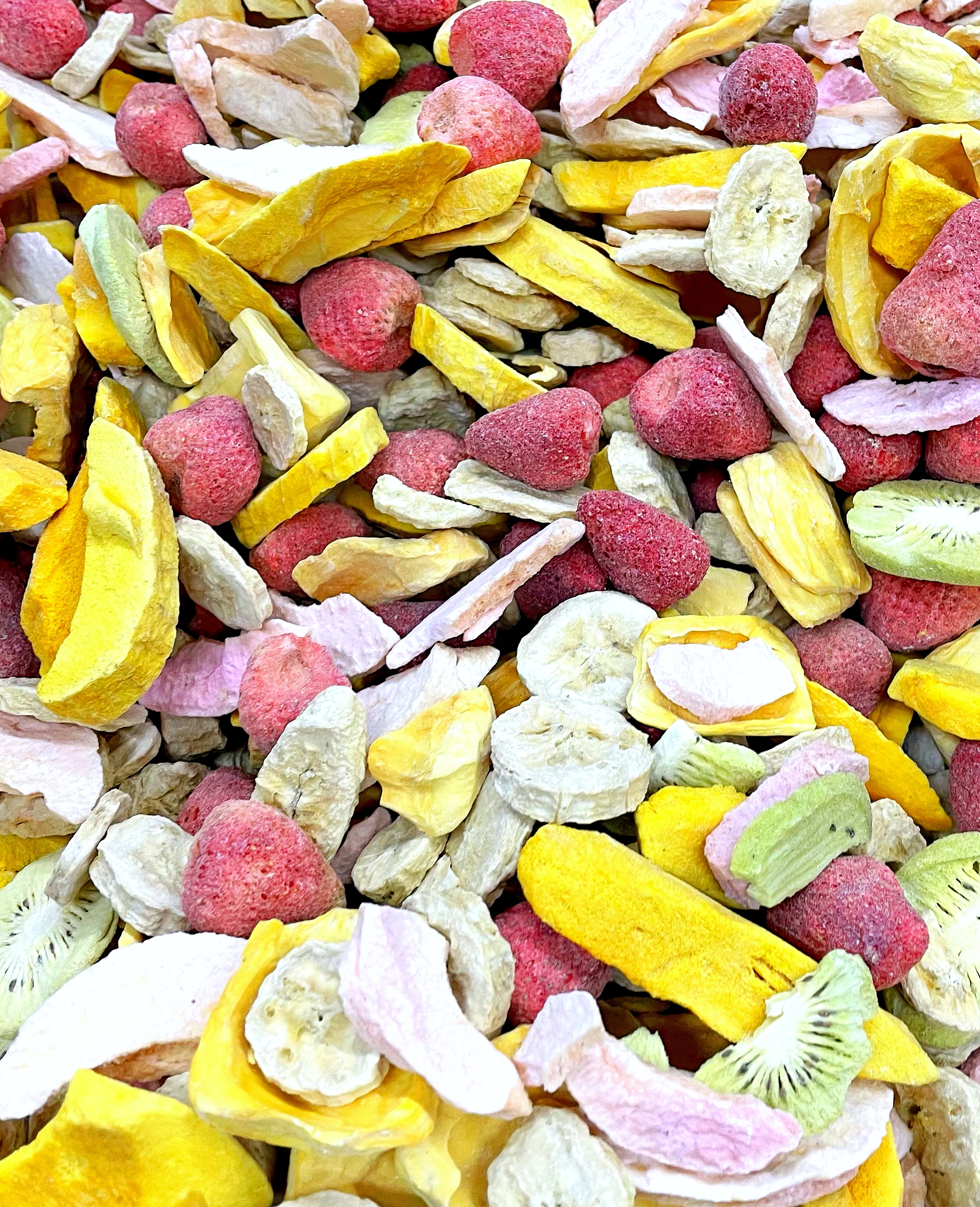
The most widely used freeze dried fruits in product development include strawberries, raspberries, blueberries, mangoes, bananas, and pineapples. Each variety offers distinct flavor profiles, color contributions, and nutritional attributes that make them suitable for different product categories. Strawberry and raspberry powders are particularly popular in confectionery and dairy applications, while mango and pineapple are frequently used in tropical-themed beverages and snack products. The choice of variety should be driven by the target consumer profile, desired sensory outcome, and nutritional positioning of the finished product.
Because freeze dried fruits have very low moisture content and water activity, they can absorb moisture from surrounding ingredients or the ambient environment. This moisture migration behavior must be carefully managed during formulation to prevent textural changes such as softening or clumping. Product developers typically address this by selecting appropriate packaging with moisture barrier properties, controlling the water activity of the overall formulation, and choosing particle sizes that minimize surface area exposure. When properly managed, freeze dried fruits remain stable and maintain their intended textural contribution throughout the product shelf life.
Yes, freeze dried fruits are widely available in certified organic and non-GMO formats, making them highly compatible with clean label and specialty certification product strategies. Ingredient suppliers typically offer documentation such as organic certificates, non-GMO project verification, and allergen declarations that support compliance with retailer and regulatory requirements. Product developers pursuing these certifications should verify the full supply chain documentation with their ingredient supplier during the early stages of formulation to avoid complications during product approval and listing processes.
Freeze dried fruits command higher ingredient costs than conventionally dried or fresh alternatives, but they also enable meaningful premium pricing at the retail level. Their association with quality, naturalness, and advanced processing technology positions products that feature them as premium within their category. Consumer research consistently shows that shoppers are willing to pay more for products containing real, identifiable fruit ingredients. By communicating the use of freeze dried fruits clearly on packaging and in marketing materials, brands can justify higher price points, improve margin structures, and build a loyal consumer base that values quality over price.

 EN
EN

 Hot News


